Chapter 2.7 — Memory & Packaging
A fast logic die is useless if data cannot reach it, and an allocated wafer is useless if memory or packaging fails qualification. The scarce unit in this layer is not nominal capacity; it is qualified, deliverable capacity. That distinction explains why memory and packaging can capture a rising share of the system without owning the model or the accelerator architecture.
An AI accelerator is not one chip but an assembly. At its center is the logic die that does the computing, and stacked right beside it is high-bandwidth memory (HBM), several dozen layers of DRAM bonded into towers that feed the processor. The reason this matters is that modern models are limited less by how fast a chip can calculate than by how fast it can be fed data, the "memory wall." More and faster memory, placed as close as physically possible to the compute, is what breaks that wall. Advanced packaging is the manufacturing art of putting all of it, logic and memory, onto one tightly-integrated module; the dominant method, TSMC's CoWoS, is what physically makes a modern GPU possible. Neither layer designs the chip, but without them there is no chip.
Think of the logic die as a very fast kitchen and memory as the pantry. Adding more cooks does not increase the number of meals if ingredients arrive through one narrow door. Modern accelerators contain an enormous amount of arithmetic capacity, but model weights and intermediate results must be moved into that capacity continuously. Ordinary memory located farther away cannot supply enough data without unacceptable delay and power. HBM solves the problem by stacking memory dies and placing them beside the processor on the same package.
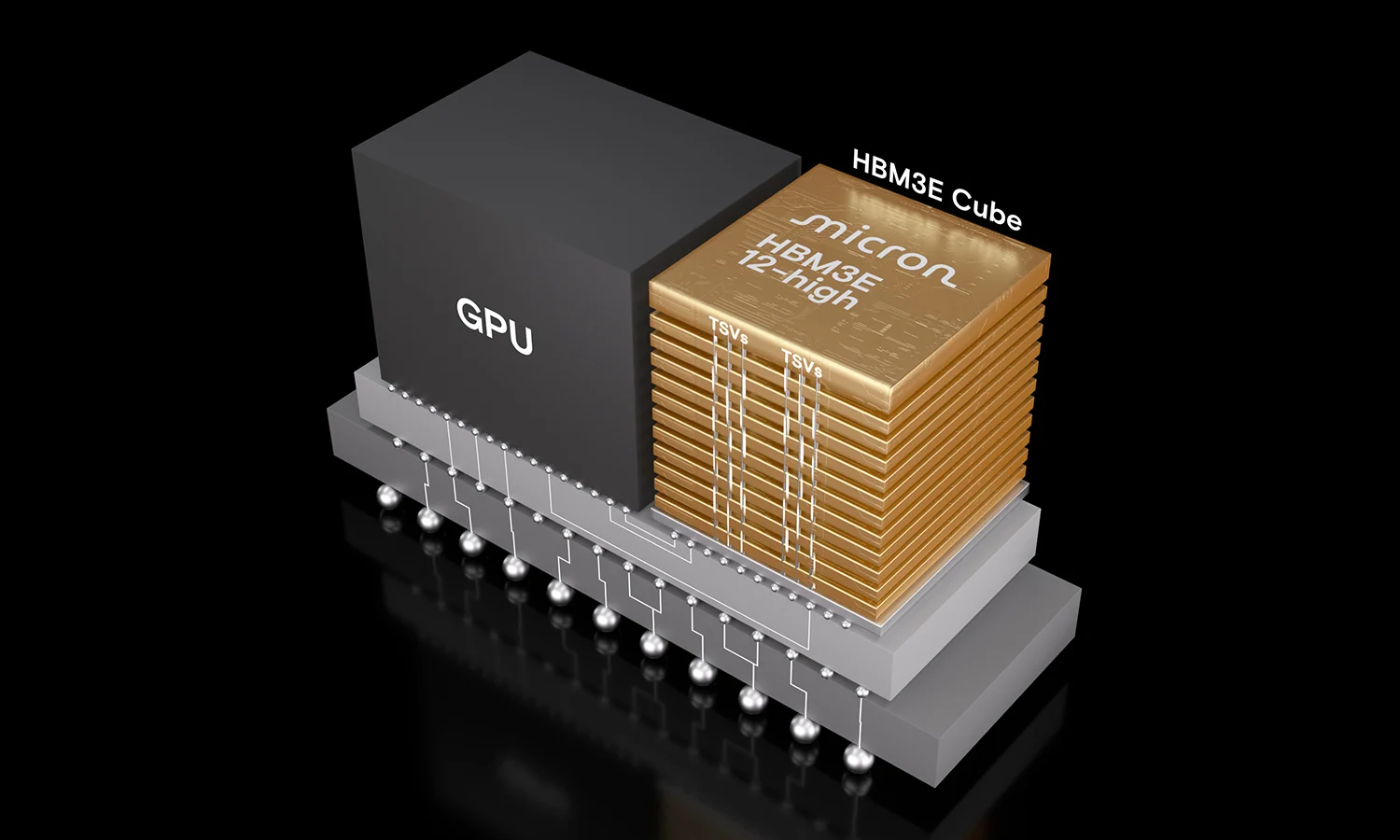
This arrangement replaces one simple component with a chain of tightly coupled manufacturing steps. The memory dies must work. The stack must be bonded correctly. The logic die and memory must be placed on a large interposer. The substrate, insulating films, underfill, and package must survive heat and electrical stress. One defective or late part can prevent several valuable components from becoming a saleable accelerator.
The unit that matters is therefore not a memory maker’s announced wafer capacity or a packaging plant’s nominal floor space. It is qualified output for a specific customer platform. Qualification means the component has passed the customer’s performance, reliability, thermal, and manufacturing tests and can be supplied at acceptable yield. Capacity that has not qualified cannot fill the order, and capacity qualified for one generation may not transfer automatically to the next.
Why a GPU can lose to data it cannot receive
The clearest way to see this layer's importance is in the bill of materials. On Nvidia's A100 a few years ago, HBM was roughly a fifth of the component cost. On the current Blackwell generation it is more than half, and on the coming Rubin generation it is tracking toward nearly two-thirds.1

That shift is the whole investment thesis for this layer. As Chapter 2.8 explains, shrinking transistors now costs more and delivers less, so the extra performance each GPU generation needs comes increasingly from more memory and better packaging rather than from the logic die alone. Memory is no longer a commodity component bolted on at the end; it is becoming the most expensive and most differentiated part of the chip, and with HBM4 its base layer is being built on a logic process at TSMC, tying the memory makers and the foundry together and opening the door to semi-custom HBM designed for a specific customer's chip.
HBM supply means qualified supply
The layer runs from the three memory makers through the packaging houses to a set of Japanese materials suppliers that most investors have never heard of but that gate the whole thing.
| Player | Ticker | Role |
|---|---|---|
| SK Hynix | 000660.KS | HBM leader (~57% bit share) |
| Micron | MU | HBM #3; the accessible US pure-play |
| Samsung | 005930.KS | HBM #2 (turnaround) + foundry |
| CXMT | (A-share, new) | China's DRAM champion; HBM laggard |
| TSMC | TSM | CoWoS packaging monopoly |
| Amkor, ASE/SPIL | AMKR, ASX | OSAT packaging overflow |
| Besi | BESI | hybrid bonding (next-gen) |
| Ibiden, Shinko | (Japan) | high-end substrate (>70%) |
| Ajinomoto | (Japan) | ABF insulating film (>95%) |
| Resonac, Namics | (Japan) | molding compounds, underfills |
| SK Absolics, Corning | SKC, GLW | glass substrates (the coming shift) |
The table spans several different economic positions. Memory makers sell a large, high-value component and bear the cyclicality of semiconductor capacity. TSMC controls the scarce process that assembles the most advanced systems. Outsourced assembly companies can receive overflow but may not own the highest-value customer relationship. Substrate and material suppliers sell less expensive inputs, yet qualification can make those inputs extraordinarily difficult to replace.
This is why bill-of-material share and investment leverage are not the same. HBM can account for a large share of component cost and produce visible revenue growth. A specialty film may account for very little cost but still stop production if it is unavailable. The former offers larger addressable content; the latter may offer deeper switching friction. Security returns depend on how much each exposure matters to the supplier’s own income statement and whether the supplier can price that scarcity.
Three memory vendors compete on qualification as much as capacity
The HBM market is a tight oligopoly of three. SK Hynix is the clear leader, with about 57% of HBM bit shipments, having won the Nvidia relationship early and held it. Samsung is fighting to recover lost ground at around 22%, and Micron, the sole American maker, has climbed to about 21%.2

The coming HBM4 generation is the 2026 event, and it changes the competitive stakes. All three vendors qualified for Nvidia's Rubin platform, with the split expected around 50% SK Hynix, 30% Samsung, and 20% Micron, and because HBM is sold out the pricing power sits with the sellers. HBM4 sells for around $500 per stack, more than $10 per gigabyte against $7–8 for the prior generation. The deeper change is that HBM4's base die moves to a logic process fabricated at TSMC, which both couples the memory makers to the foundry and turns HBM from a commodity into a semi-custom product, potentially eroding the brutal price cyclicality that has always defined memory. The two open questions are whether Samsung's yields recover enough to hold its 30% slot after missing the prior generation's qualification, and whether TSMC's role in the base die hands the foundry leverage over the memory makers. Micron is the most accessible pure-play for a US investor; SK Hynix and Samsung trade in Korea.
CoWoS cannot be measured by wafer starts alone
Packaging is even more concentrated than memory, and it hides some of the most extreme single-supplier dependencies in the entire supply chain. TSMC's CoWoS is the gating resource for the whole AI-chip industry, and its capacity, around 70,000–80,000 wafers a month at the end of 2025, is being pushed toward 120,000–130,000 by the end of 2026, with the overflow subcontracted to Amkor and Taiwan's SPIL. Nvidia alone is expected to consume roughly 700,000 CoWoS wafers in 2026. Beneath the package sits the substrate, and here a Japanese duopoly of Ibiden and Shinko holds more than 70% of the high-end, with Ibiden the dominant supplier for Nvidia's top GPUs and spending ¥500B to expand.
The wafer count can mislead because newer packages grow in physical area and complexity. If one next-generation system consumes more interposer area, more HBM stacks, or additional bonding steps, a capacity increase measured in wafer starts may not produce the same increase in completed accelerators. Yield also compounds across the assembly. The operator does not get paid for a partially successful package; it needs a completed unit in which several expensive dies all work together.
The investor should therefore separate three measures: installed tool capacity, qualified package capacity, and good completed packages delivered. Only the third produces the accelerator shipment. Expansion announcements concern the first; customer qualification concerns the second; revenue and usable system output depend on the third.
The most extreme chokepoint of all is nearly invisible: Ajinomoto, a Japanese company better known for seasoning, makes more than 95% of the insulating film (ABF) that every high-end chip package is built on, and it raised prices about 30% for the second half of 2026. Around it sit other Japanese materials names that gate the layer: Resonac supplies the epoxy molding compounds and Namics the underfills that hold these packages together. The next shift to watch is glass substrates, which promise large speed and power gains over today's organic substrates: SK Absolics (a unit of SKC) is preparing mass production in Georgia with samples to AMD, Intel has begun licensing its glass technology, Samsung targets glass interposers by 2028, and Corning and Japan's AGC supply the glass itself. These are the sort of single-supplier dependencies that do not show up in headlines until they break.
This layer makes allied manufacturing indispensable
The national map of this layer is distinctive. Memory is a Korean and American strength: SK Hynix and Samsung in Korea, Micron in the US, with Japan and Taiwan supplying the materials and the packaging. China is conspicuously behind. Its DRAM champion, CXMT, is scaling fast and just completed the largest chip IPO of 2026, but it trails badly in HBM specifically, and Huawei's push to build its own HBM for the Ascend accelerators of Chapter 2.5 is an attempt to close a gap that is currently one of the two hardest constraints on China's entire AI-chip effort. The other, leading-edge fabrication, is Chapter 2.8.
This is the layer, more than almost any other, where export controls bite China hardest. High-bandwidth memory has been a specific target of restrictions, because it is the component China can least easily substitute, and its scarcity is why Chinese accelerators lean on stockpiled or domestically-produced memory that lags the frontier. Packaging is similar: the CoWoS capacity that makes Western AI chips is in Taiwan, and China is building domestic advanced-packaging capacity but from well behind. For an investor the read is that memory and packaging are where the American and allied position is strongest and the Chinese position weakest, the mirror image of the materials layer in Chapter 2.10.
What determines whether today's shortage persists
Three observations determine whether the shortage survives. The first is the HBM4 ramp and whether it stays sold out, which would preserve the pricing power that makes memory such an attractive part of the chain right now; the risk is that memory is historically cyclical, and every past boom has ended in oversupply and a price crash. The second is whether Samsung's yields recover enough to hold its 30% HBM4 share or whether SK Hynix extends its lead. The third is packaging capacity: whether TSMC's CoWoS expansion actually relieves the bottleneck or whether each new GPU generation, consuming ever more package area, keeps demand ahead of supply. And a slower structural question runs underneath: whether glass substrates begin to displace organic ones and reshuffle the substrate hierarchy later in the decade.
Read the bottleneck as a chain, not as three separate markets
Suppose a customer has enough accelerator logic dies but receives fewer HBM stacks than planned. Finished accelerator shipments fall, so packaging tools and substrates allocated to that platform may also run below plan. Now reverse the constraint: HBM is available, but qualified CoWoS capacity is late. The memory maker can report strong orders while the customer still cannot commission the system. A shortage at either stage can make the other stage’s capacity look abundant even though end demand has not changed.
This interaction is why isolated capacity forecasts so often produce the wrong cycle call. The investor needs a matched view of logic-die output, HBM stacks per package, good HBM yield, interposer or package area, qualified packaging throughput, and complete-system build schedules. The tightest element sets near-term shipment volume. When that constraint expands, the bottleneck can migrate rather than disappear.
The financial impact also differs by contract. A memory supplier with committed pricing may recognize revenue when qualified stacks ship, before the accelerator system is commissioned. A packaging provider may depend on customer wafer input and completed-package acceptance. A specialty-material supplier can grow more steadily with process steps but may have much smaller content per unit. One platform delay can therefore produce different revenue timing across companies exposed to the same end system.
The most useful evidence is a reconciliation: do supplier shipments, packaging output, accelerator deliveries, and customer deployments describe roughly the same ramp? If one line runs far ahead, inventory may be building somewhere in the chain. If all lines rise while lead times and pricing normalize, content growth may be replacing shortage as the investment driver. That transition can support a good business even after the most dramatic scarcity premium fades.
How content growth passes through the memory cycle
Micron (MU) is the most accessible US-listed pure-play in the memory group, while SK Hynix (000660.KS) is the HBM leader and Samsung (005930.KS) a turnaround case for investors with Korean-market access. All remain exposed to memory-cycle supply response. The packaging constraint accrues partly to TSMC (TSM), with Amkor (AMKR) and ASE (ASX) as outsourced-assembly alternatives and Besi (BESI) exposed to hybrid bonding. Ibiden and Ajinomoto are difficult-to-replace substrate inputs but may be less accessible; SK Absolics and Corning (GLW) are longer-dated glass-substrate options. Memory and packaging capture a rising share of system value, but capacity additions, qualification and entry valuation determine whether that trend produces excess returns.
What would end the shortage economics
The biggest risk to this layer is its own history: memory is cyclical, and the current sold-out, high-price condition has always, eventually, given way to oversupply and a brutal price decline. A wave of new HBM capacity arriving faster than demand, or any stumble in AI-chip build rates, would hit the memory makers hard and fast, and the same efficiency shock that threatens the compute layer would flow through here too. On the packaging side, the thesis weakens if CoWoS capacity finally overshoots demand, turning a scarce, high-margin service into a commodity. And a genuine Chinese breakthrough in domestic HBM, which is not close today, would over time erode the allied advantage that makes this layer such a clean expression of the Western position in AI.
For the package-to-system mapping of HBM3E, HBM4, host memory and disclosed supplier relationships, see §2.13.
The chapter’s usable conclusion is a sequence, not a shortage label. First track memory content per accelerator and package area per system. Then ask how much announced capacity is qualified for the platform that is actually shipping. Next compare customer allocations with supplier expansion and yield. Finally, watch contract prices, inventory, and lead times for evidence that supply is catching demand.
The best part of the cycle occurs when content per system is rising, qualified capacity remains scarce, and the supplier has not yet expanded enough to destroy pricing. The dangerous part begins when capital spending responds to peak prices just as end demand or system builds slow. Memory and packaging can remain technologically essential throughout both phases. The stock return depends on recognizing which phase the income statement is entering.
Sources
Linked evidence for this chapter's figures and load-bearing claims: 2 1
Footnotes
-
The Memory Triopoly. Wing Venture Capital, undated; accessed 2026-07-25. ↩ ↩2
-
Global DRAM and HBM Market Share: Quarterly. Counterpoint Research, undated; accessed 2026-07-25. ↩ ↩2