Chapter 2.11 — Capital & Market Structure
When capital spending outruns operating cash flow, the AI cycle stops being only a technology question. It becomes a question of who owns the depreciating asset, who provides the credit, and whose balance sheet absorbs a utilization shortfall. This chapter follows the financing chain before asking whether the eventual application cash flow can repay it.
Every prior chapter described something being built. This one describes how it is paid for and how markets are pricing it, because the durability of the money is ultimately what determines whether the whole edifice stands. Several features define the current moment: capital spending on a scale without real precedent, reflexive financial loops that link the major players together, a stock market whose gains have concentrated into a handful of names, a rising reliance on debt, and a private market pricing artificial general intelligence as if it had already arrived. Each is a source of both the boom's momentum and its fragility.
Start with the financing chain of a data center. A cloud company or specialist operator first commits capital to land, power, construction, accelerators, networking, and cooling. Equipment suppliers can receive orders and deposits before the site operates. The operator begins paying interest and eventually depreciation. A model laboratory or enterprise customer then rents the capacity. Only after that customer earns subscription, API, advertising, or productivity revenue does external cash begin to repay the physical build.
The chain can be healthy even when spending comes first; railways, telecom networks, and cloud computing were all built before full demand appeared. The risk arises when several participants finance one another and the final external payer remains small. A chip vendor invests in a laboratory, the laboratory signs a compute contract, the infrastructure operator borrows to buy the vendor’s chips, and the original vendor records the sale. Every transaction may be legally and economically real, yet the system still depends on outside customers eventually paying enough for AI services.
This chapter therefore separates installed capital, contracted revenue, and external cash generation. Installed capital shows what has been built. Contracts show what counterparties have promised. External cash shows whether users outside the financing loop value the output enough to sustain it. The first two can expand much faster than the third for a time. They cannot do so indefinitely.
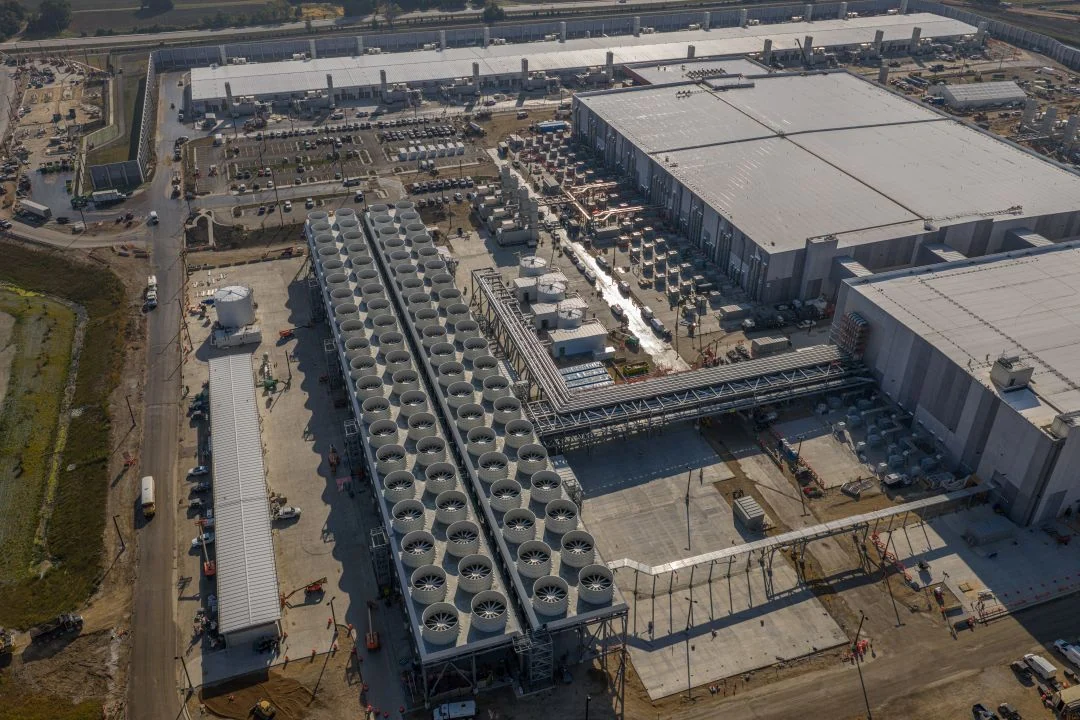
Capital spending has outrun the cash that funds it
The spending is the foundation, and its trajectory is vertical.

The four largest hyperscalers are guiding to roughly $725B of capital spending in 2026, up about 77% from the prior year, with the five-company total including Oracle running higher still. Company by company, the guidance is staggering: Amazon around $200B (roughly double 2025), Alphabet $180–205B (raised twice, up from about $85B in 2025), Microsoft above $120B for the fiscal year, and Meta $125–145B. Goldman Sachs projects cumulative hyperscaler capex across 2025–27 above $1.15T, more than double the prior three years. The critical, and newer, fact is that this spending now exceeds the operating cash flow of the companies doing it; Amazon's trailing free cash flow has compressed to near $1B. When capex outruns cash, the balance has to come from debt, and the market's mood has shifted from rewarding capital spending to interrogating the return on it: when Alphabet beat earnings but raised its capex guidance in July 2026, the stock sold off.12
Who holds the asset, the credit, and the residual risk
The money flows through a recognizable cast: the hyperscalers who spend, the labs and neoclouds who consume, the vendor who finances its own customers, and the private-credit managers who increasingly fund it all.
| Player | Ticker | Role in the AI money |
|---|---|---|
| Microsoft, Alphabet, Amazon, Meta | MSFT, GOOGL, AMZN, META | the ~$725B/yr capex spenders |
| Oracle | ORCL | Stargate; a debt-funded RPO of ~$500B+ |
| OpenAI, Anthropic, xAI | PVT | the labs raising record private rounds |
| CoreWeave, Nebius | CRWV, NBIS | neoclouds funded by GPU-backed debt |
| Nvidia | NVDA | vendor-financier: equity stakes in OpenAI, CoreWeave, Nebius |
| Blue Owl, Apollo, Blackstone, Ares, Brookfield | OWL, APO, BX, ARES, BAM | private-credit originators of the data-center debt |
| PIMCO, BlackRock | (PIMCO PVT), BLK | anchor buyers of the debt |
| SoftBank, MGX | PVT | Stargate and mega-round backers |
Circular financing can create supply before it proves demand
The most-discussed feature of this cycle is the way the money moves in circles.

Nvidia invests in OpenAI; OpenAI commits large sums to Oracle and CoreWeave for computing capacity; and those providers buy Nvidia chips, sometimes with financing connected to Nvidia's own investments. The links include Nvidia's initial “up to $100B” OpenAI commitment, later described as a roughly $30B stake; the OpenAI–AMD deal that granted the customer warrants for up to 160M AMD shares; Oracle's roughly $300B, five-year Stargate commitment inside a remaining-performance-obligation book above $500B; and Nvidia's roughly $2B equity investments in each of CoreWeave and Nebius. Published estimates place the aggregate circular network between about $800B and $1.4T, but the definition varies. The Bank for International Settlements warns that such arrangements can overstate independent demand and transmit stress faster than a conventional supply chain. Nvidia's revenue quality and OpenAI's funding capacity must therefore be assessed together.34
Market concentration makes different securities share one failure mode
The stock market that owns all of this has concentrated to a degree not seen in a generation.

The Magnificent Seven make up roughly 32.5% of the S&P 500's market value, and the top ten companies about 40% of the index. Apollo chief economist Torsten Sløk describes this concentration as more extreme than the 1990s peak. Passive and target-date flows leave index investors with substantial AI exposure whether they select it deliberately or not. Leadership changed in 2026: the Magnificent Seven fell about 3.7% year to date while the other 493 S&P names rose about 12.9%. Alphabet sold off after raising capital-spending guidance, Palantir fell about 26% despite guiding to 71% revenue growth, and short interest concentrated in neoclouds, Super Micro, and small-modular-reactor companies. These reactions show that strong operating growth can coexist with falling security prices when expectations and concentration are already high.5
The weakest link is moving from equity into credit
Because capital spending exceeds cash flow, more of the build is funded by debt. The five hyperscalers issued roughly $121B of investment-grade bonds in 2025, more than four times the prior five-year average, and 2026 year-to-date AI-related debt issuance reached about $489B. Private credit includes Meta's roughly $30B off-balance-sheet financing with Blue Owl and PIMCO, while CoreWeave has accumulated more than $14B in GPU-collateralized facilities. The private-credit market has grown from about $100B in 2010 to roughly $2.2T in 2026, with an estimated $800B needed for AI infrastructure through 2028. The BIS and IMF identify financial-stability concerns because GPU collateral depreciates quickly and some leverage sits in less-regulated structures. Hyperscaler and data-center credit spreads, collateral terms, and downgrades of GPU-backed securities are the relevant indicators.
The build is durable only if application cash flow catches up
Three pieces of evidence frame the return debate. MIT's Project NANDA found that roughly 95% of enterprise generative-AI pilots delivered no measurable profit. Michael Burry argued in late 2025 that hyperscalers could understate depreciation by roughly $176B across 2026–28 by extending the assumed useful life of rapidly obsolescing chips; he estimated that this could overstate Oracle's earnings by about 27% and Meta's by about 21% by 2028. Sequoia's David Cahn estimates that about $1.5T of 2026 AI-infrastructure spending requires roughly $3T of revenue to justify, while Bain estimates about $2T of new AI revenue is needed by 2030. The opposing case is that monetization normally lags infrastructure spending. Resolving the disagreement requires comparable revenue disclosure, utilization, useful-life assumptions, and cash returns—not a general declaration that AI is or is not a bubble.
Private valuations move the payoff farther into the future
Private valuations are exceptionally high. OpenAI closed a $122B round at an $852B valuation in March 2026; Anthropic reached $965B on a $65B round in May; xAI was valued at $250B inside SpaceX's roughly $1.25T after an all-stock merger; and Anysphere (Cursor) moved from a $29B round to discussions above $50B. These negotiated marks include liquidation preferences and are not directly comparable with common-stock market capitalization. Public-market price discovery is expanding: CoreWeave has traded since 2025, Cerebras listed in 2026, China's CXMT staged a large A-share IPO, Databricks delayed its listing to late 2026, and an OpenAI filing was reported for mid-2026. Retail vehicles such as Destiny Tech100 (DXYZ), which has traded at a 50–200% premium to net asset value, ARK Venture, and Robinhood Ventures add access but can introduce an additional valuation premium.
Talent transactions reveal the scarcity hidden from financial statements
A quieter but revealing feature is how the giants acquire capability without triggering merger review. Google, Microsoft, Amazon, Meta, and Nvidia deployed more than $40B through "reverse acqui-hires" from 2024 to mid-2026: Microsoft licensed Inflection's team for about $650M, Google took Character.AI's founders for about $2.7B and Windsurf's leadership for about $2.4B after OpenAI's deal collapsed, and Meta paid about $14B for 49% of Scale AI and its founder. Compensation escalated to match, with Meta's Superintelligence Labs reportedly offering packages up to $300M over four years. In February 2026, Senators Warren, Wyden, and Blumenthal urged the FTC and DOJ to probe these structures as "de facto mergers" designed to bypass review, and inquiries were reportedly opened. For an investor the structures are cheap optionality for the incumbents but carry a new regulatory tail, and the comp inflation is a margin headwind for the labs and a signal that human capital, not just GPUs, is a binding constraint.
China socializes more of the build and obscures more of the return
The capital story is largely an American one, and that is itself the point. The circular financing, the private megarounds, the crowded mega-cap trade, and the GPU-backed debt are all features of the US market. China builds its AI on a different capital structure: state guidance funds, the national semiconductor "Big Fund," state-enterprise balance sheets, and government subsidies, rather than venture capital and public equity. That brings its own risks, which the China dossier details: pledged shares (股权质押) that can force selling, subsidies that inflate reported profit (so read the non-GAAP line), state-fund selling overhangs (大基金减持), and fabricated order rumors (小作文). A Chinese AI champion is less likely to be caught in a circular-financing unwind and more likely to be exposed to a shift in state policy. The two systems concentrate their financial risk in different places.
Refinancing and cash conversion are the decisive tests
The signals to watch are financial rather than technological. The first is whether any hyperscaler cuts or pauses its 2027 capex guidance; none has, and the first to do so would be the regime-change signal for the entire supplier complex. The second is credit: spreads on hyperscaler and data-center debt, and any downgrade of GPU-backed securities, are the leading indicators the equity market will lag. The third is quality of earnings, specifically whether any hyperscaler shortens its depreciation assumptions, which would validate the bears and cut reported profits at the most exposed names. And the fourth is the private market, where a down-round or a delayed IPO at OpenAI or Anthropic would transmit through the circular loop quickly.
Who can earn without owning the utilization risk
One way to obtain exposure to this financing cycle without owning the most levered operators is through private-credit and alternative-asset managers such as Blue Owl (OWL), Apollo (APO), Blackstone (BX), and Ares (ARES), which collect fees for originating and managing debt. They exchange direct operating risk for credit-cycle, fundraising and underwriting risk. Among operating companies, the discipline is to compare cash earnings, depreciation policy, customer financing and related-party revenue before treating reported growth as external demand. Portfolio construction should also account for the fact that hyperscalers, neoclouds, electrical suppliers and lenders can all be exposed to the same capex reversal.
How a financing shock propagates through the stack
A hyperscaler capital-spending cut, broad credit-spread widening, a GPU-ABS downgrade, a major private down-round, or shorter depreciation lives would signal a shift from expansion toward contraction. Circular financing could transmit any of these shocks across suppliers quickly. The constructive case requires AI revenue to close the gap with capital spending, enterprise returns to broaden, and related-party commitments to convert into cash-paying external demand. Disclosed AI revenue should be compared with depreciation, interest, power, and ongoing upgrade costs.
The monitoring order should follow the cash. Start with application revenue and customer renewal, because that is the independent source of payment. Compare it with cloud revenue, capital expenditure, depreciation, and operating cash flow. Then inspect the counterparties behind backlog and remaining performance obligations: how concentrated are they, and what capital must be spent before the revenue can be recognized? Finally, monitor refinancing cost, collateral value, and credit spreads for the operators that cannot fund the build internally.
The conclusion is neither “debt makes the AI boom a bubble” nor “large technology companies can afford anything.” Financing changes who absorbs the timing error. Cash-rich hyperscalers can tolerate a longer adoption curve; leveraged specialists cannot. Equipment suppliers can earn before utilization is proved; lenders and equity holders may wait years. A sound investment identifies both the economic beneficiary and the balance sheet that carries the delay.
Sources
Linked evidence for this chapter's figures and load-bearing claims: 3 4 2 1 5
Footnotes
-
Big Tech Is on Track to Spend $750 Billion on AI This Year. Forbes, 2026-04-30; accessed 2026-07-25. ↩ ↩2
-
What the capex boom means for stock investors. Goldman Sachs, 2026-07-21; accessed 2026-07-25. ↩ ↩2
-
The AI investment race. Bank for International Settlements, 2026-07-14; accessed 2026-07-25. ↩ ↩2
-
From OpenAI to Nvidia, firms channel billions into AI infrastructure as demand booms. Reuters, undated; accessed 2026-07-25. ↩ ↩2
-
Why the Mag 7 stocks are underperforming the S&P 500 in 2026. Investing.com, 2026-07-18; accessed 2026-07-25. ↩ ↩2